
Here’s the question link on LeetCode 442. Find All Duplicates in an Array:
https://leetcode.com/problems/find-all-duplicates-in-an-array/description
Contents
Brute Force – O(n^2)
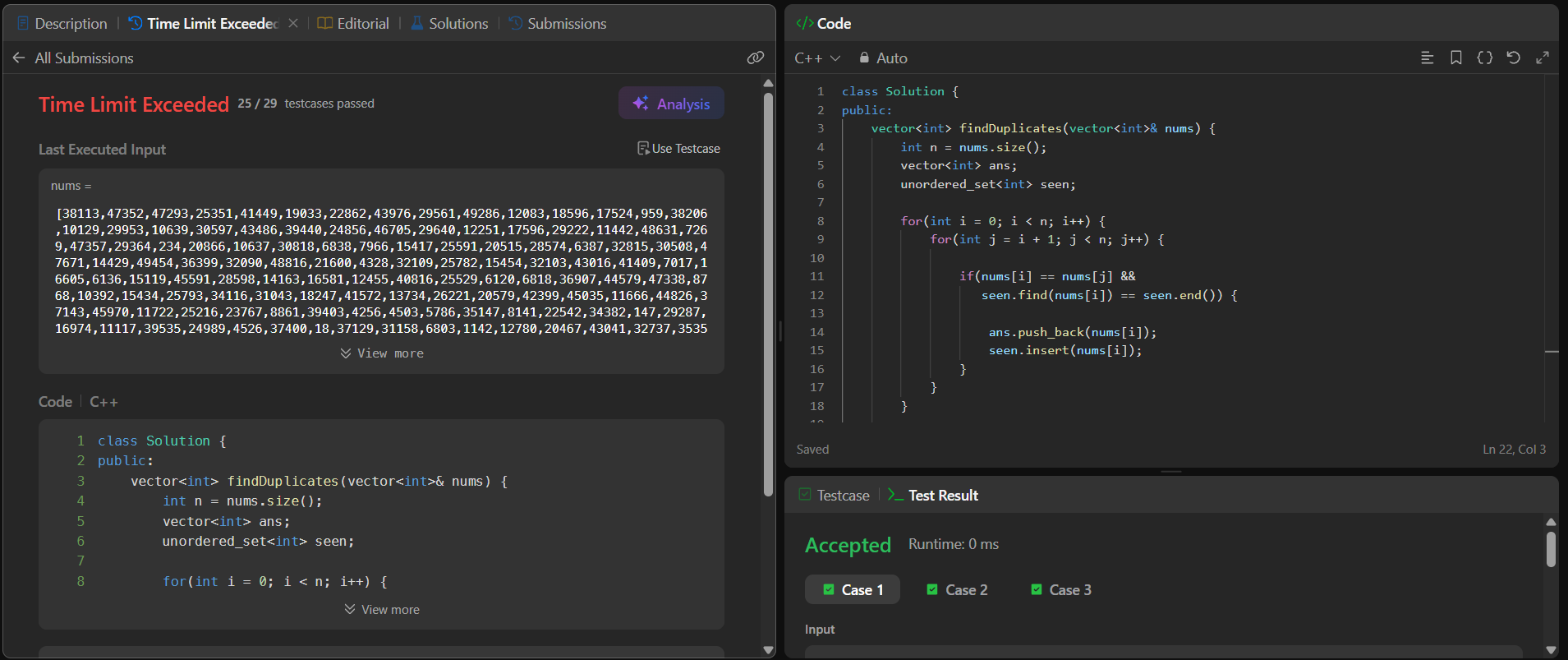
The simplest approach is to check every element against the remaining elements.
If I find the same number again, it’s a duplicate.
To avoid adding the same duplicate more than once, I can maintain a set of numbers I’ve already added to the answer.
class Solution {
public:
    vector<int> findDuplicates(vector<int>& nums) {
        int n = nums.size();
        vector<int> ans;
        unordered_set<int> seen;

        for(int i = 0; i < n; i++) {
            for(int j = i + 1; j < n; j++) {

                if(nums[i] == nums[j] &&
                   seen.find(nums[i]) == seen.end()) {

                    ans.push_back(nums[i]);
                    seen.insert(nums[i]);
                }
            }
        }

        return ans;
    }
};
Better O(n log n)
Can we avoid the nested loops?
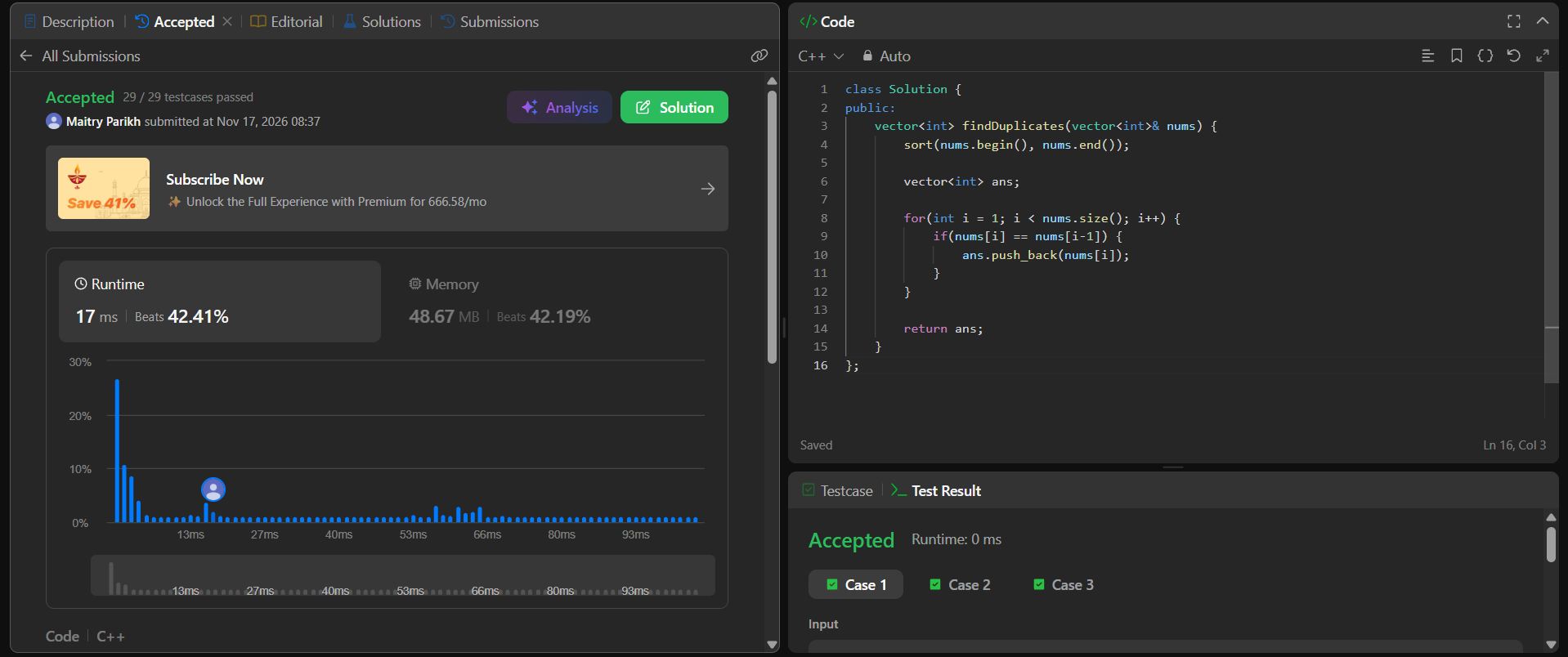
What if we sort the array first?
Once sorted, all duplicate elements will be next to each other.
For example:
[4,3,2,7,8,2,3,1]

After sorting:

[1,2,2,3,3,4,7,8]
Now we just traverse the array and check whether the current element is equal to the previous one.
class Solution {
public:
    vector<int> findDuplicates(vector<int>& nums) {
        sort(nums.begin(), nums.end());

        vector<int> ans;

        for(int i = 1; i < nums.size(); i++) {
            if(nums[i] == nums[i-1]) {
                ans.push_back(nums[i]);
            }
        }

        return ans;
    }
};
Optimal O(n)
Now here’s the interesting part.
The problem tells us that every number is between 1 and n.
So, we can actually use the array itself to keep track of which numbers we’ve already seen!
Think about it:
- Number
1corresponds to index0. - Number
2corresponds to index1. - Number
3corresponds to index2.
And so on.
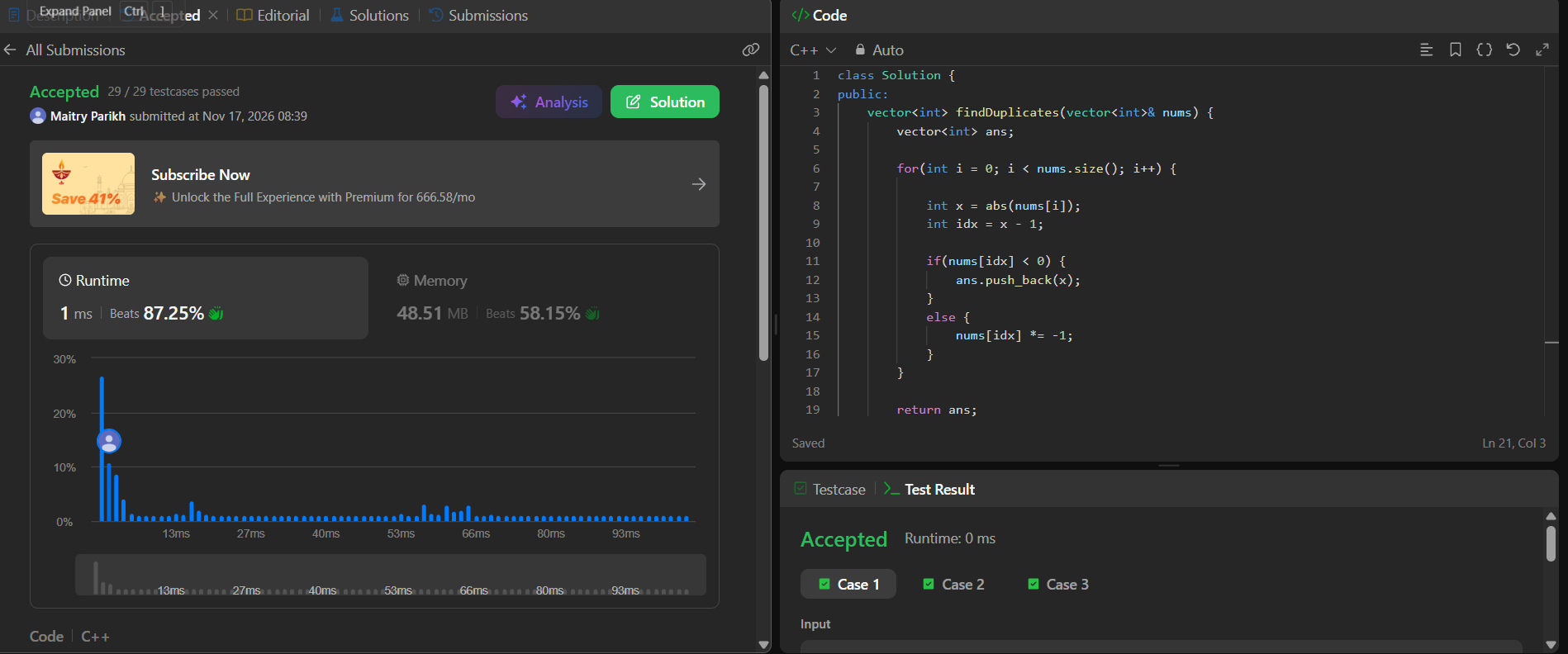
We can use the sign of the element at that index to mark whether we’ve seen a number before.
The idea:
- Pick a number
x. - Go to index
x - 1. - If the value there is positive, mark it negative. This is our first occurrence.
- If it’s already negative, we’ve seen this number before. Add it to our answer.
class Solution {
public:
    vector<int> findDuplicates(vector<int>& nums) {
        vector<int> ans;

        for(int i = 0; i < nums.size(); i++) {

            int x = abs(nums[i]);
            int idx = x - 1;

            if(nums[idx] < 0) {
                ans.push_back(x);
            }
            else {
                nums[idx] *= -1;
            }
        }

        return ans;
    }
};
Code lines explained
abs(nums[i])gets the original number because we might have already marked this position negative.x - 1gives us the index corresponding to that number.- If
nums[idx]is already negative, we’ve encountered this number before. Add it to the answer. - Otherwise, make it negative to mark that we’ve seen it.
Note: This approach modifies the input array.