
Here’s the question link on LeetCode 1. Two Sum:
https://leetcode.com/problems/two-sum/description
Contents
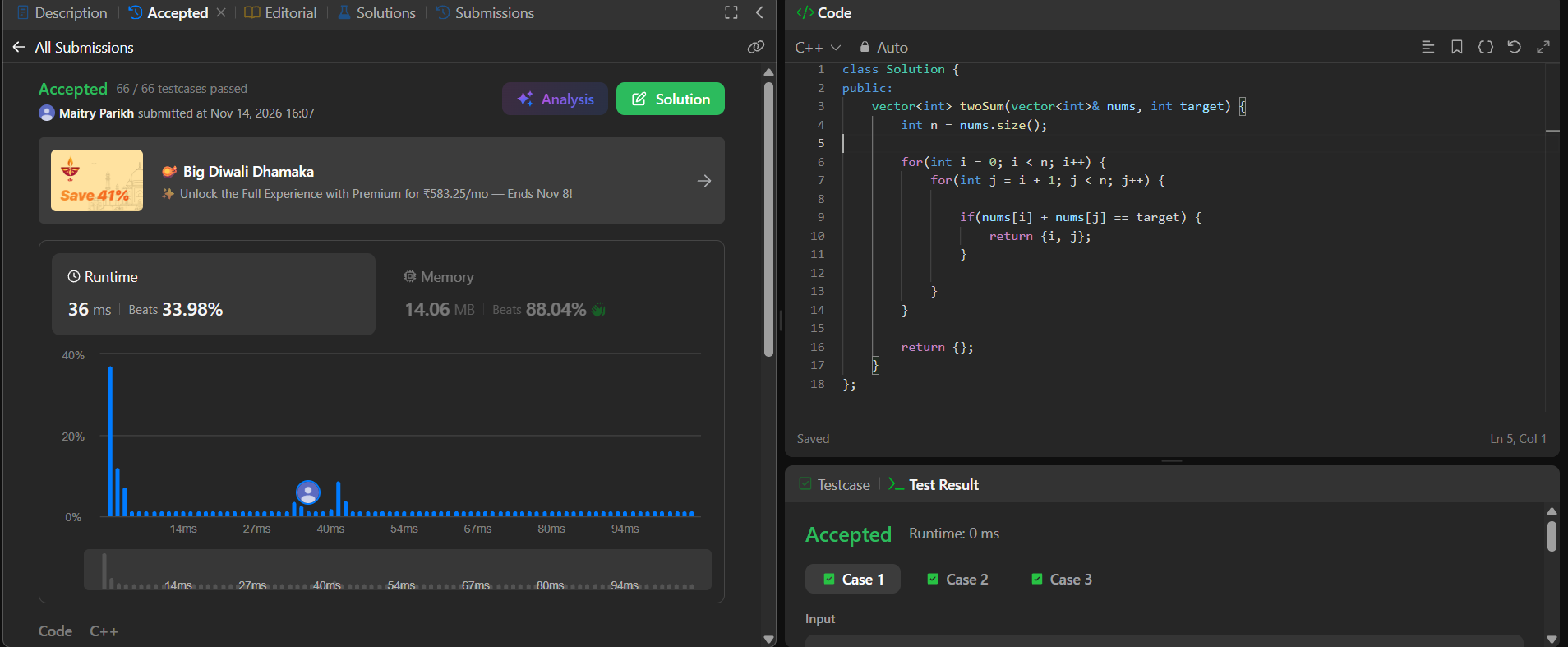
Brute Force O(n²)
The simplest approach is to try every possible pair.
I can use two nested loops, pick one element, and check every element after it to see if their sum equals the target.
If it does, return their indices.
class Solution {
public:
    vector<int> twoSum(vector<int>& nums, int target) {
        int n = nums.size();

        for(int i = 0; i < n; i++) {
            for(int j = i + 1; j < n; j++) {

                if(nums[i] + nums[j] == target) {
                    return {i, j};
                }

            }
        }

        return {};
    }
};
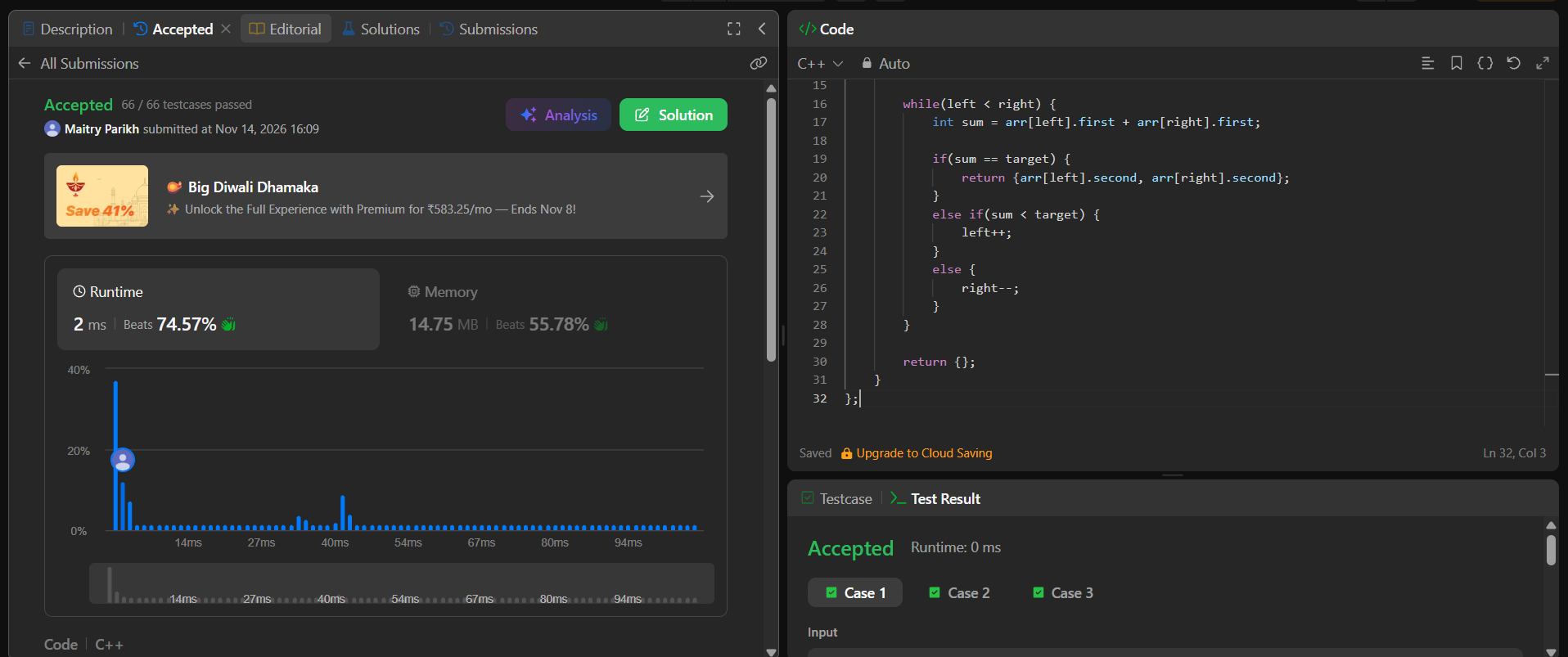
Better O(n log n) – Sorting + Two Pointers
Can we do better than checking every pair?
What if we sort the array and use two pointers?
- If the sum is smaller than the target, move the left pointer forward.
- If the sum is greater than the target, move the right pointer backward.
- If the sum equals the target, we’ve found our pair!
But there’s one catch: we need to return the original indices, not the sorted indices.
So, I’ll store each number along with its original index before sorting.
class Solution {
public:
    vector<int> twoSum(vector<int>& nums, int target) {
        int n = nums.size();

        vector<pair<int, int>> arr;

        for(int i = 0; i < n; i++) {
            arr.push_back({nums[i], i});
        }

        sort(arr.begin(), arr.end());

        int left = 0, right = n - 1;

        while(left < right) {
            int sum = arr[left].first + arr[right].first;

            if(sum == target) {
                return {arr[left].second, arr[right].second};
            }
            else if(sum < target) {
                left++;
            }
            else {
                right--;
            }
        }

        return {};
    }
};
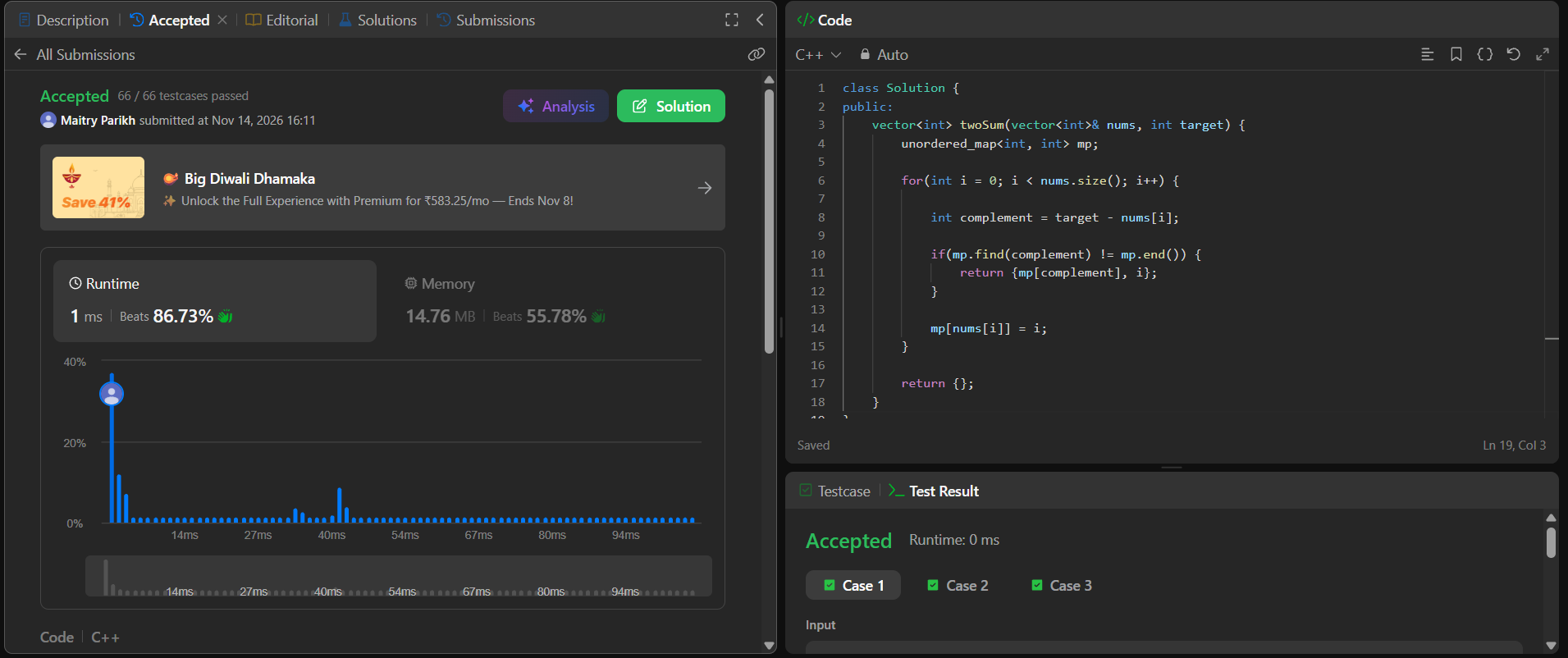
Optimal O(n) – Hash Map
Can we avoid sorting altogether?
Think about it. For every number, we already know exactly what number we need to find.
If the current number is nums[i], then the number we need is:
\[ complement = target – nums[i] \]
So, instead of searching the entire array for this complement, what if we store the numbers we’ve already visited in a hash map?
We can store number -> index.
For every element:
- Calculate its complement.
- Check if the complement already exists in our hash map.
- If yes, return both indices.
- Otherwise, store the current number and its index.
That’s it!
class Solution {
public:
    vector<int> twoSum(vector<int>& nums, int target) {
        unordered_map<int, int> mp;

        for(int i = 0; i < nums.size(); i++) {

            int complement = target - nums[i];

            if(mp.find(complement) != mp.end()) {
                return {mp[complement], i};
            }

            mp[nums[i]] = i;
        }

        return {};
    }
};
That’s it; see you in the next one.