
Here’s the question link on LeetCode 189. Rotate Array:
https://leetcode.com/problems/rotate-array/description
Contents
Brute Force O(n × k)
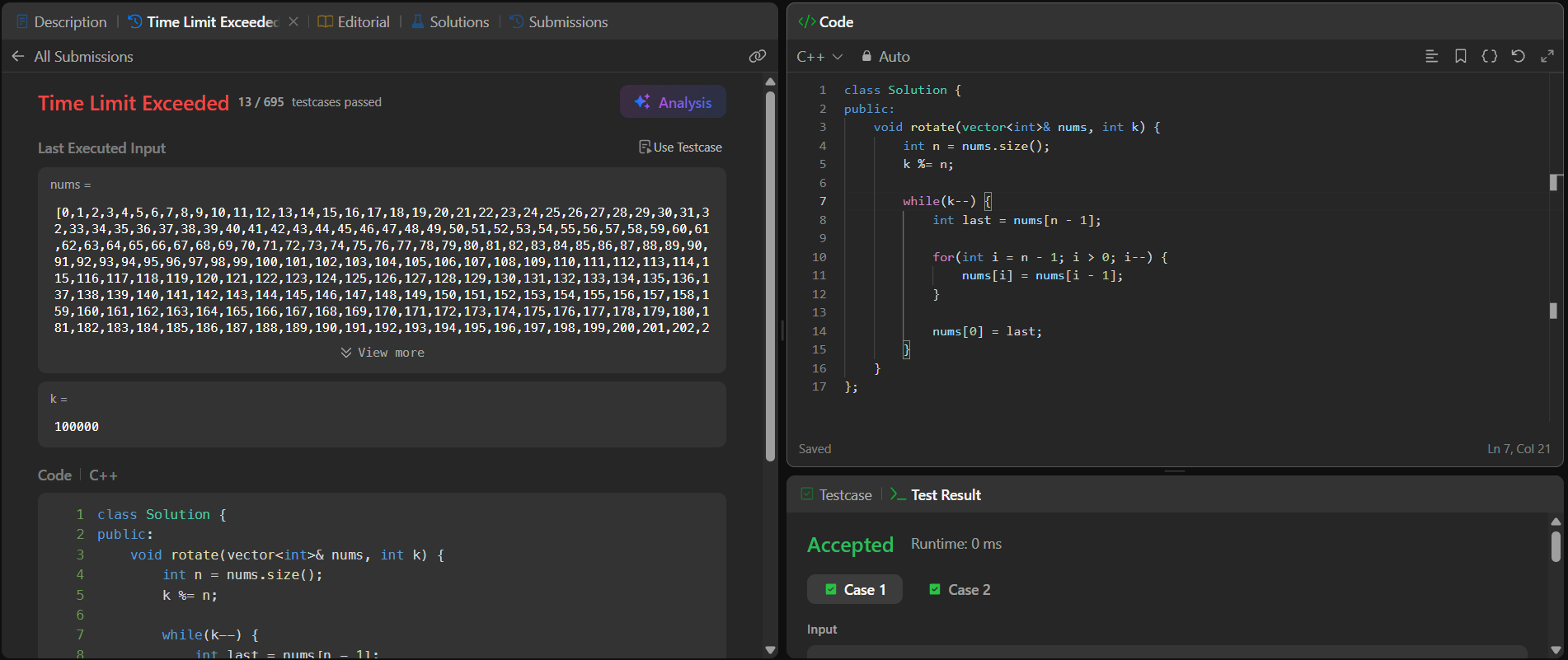
The simplest way I can think of is to rotate the array one step at a time.
For every rotation, store the last element, shift everything one position to the right, and put the last element at the beginning.
Repeat this k times.
class Solution {
public:
    void rotate(vector<int>& nums, int k) {
        int n = nums.size();
        k %= n;

        while(k--) {
            int last = nums[n - 1];

            for(int i = n - 1; i > 0; i--) {
                nums[i] = nums[i - 1];
            }

            nums[0] = last;
        }
    }
};
Complexity:
- Time: O(n × k), since we shift almost the entire array for every rotation.
- Space: O(1).
Better O(n)
Wait, why do we need to rotate one step at a time?
We already know where every element needs to go!
If an element is at index i, after rotating right by k steps, its new index will be:
(i + k) % n
So, we can create another array and directly place every element at its correct position.
class Solution {
public:
    void rotate(vector<int>& nums, int k) {
        int n = nums.size();
        k %= n;

        vector<int> temp(n);

        for(int i = 0; i < n; i++) {
            temp[(i + k) % n] = nums[i];
        }

        nums = temp;
    }
};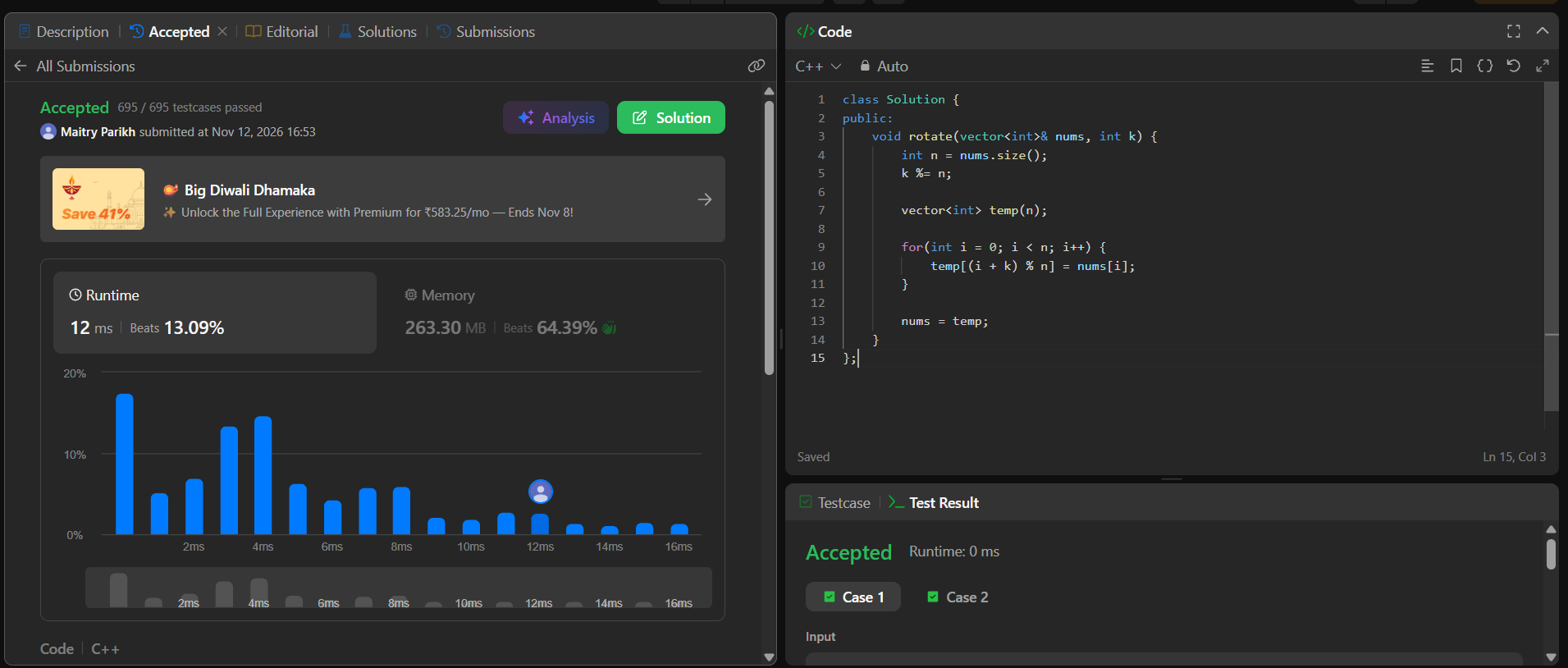
Code lines explained:
k %= nhandles cases wherekis greater than the array size.(i + k) % ngives us the final position of the current element.- Store every element at that position in
temp. - Copy the result back into
nums.
Complexity:
- Time: O(n).
- Space: O(n), for the temporary array.
Optimal O(n) and O(1) Space
Can we do this without creating another array?
Here’s the interesting part.
Think about the example:
[1,2,3,4,5,6,7]
k = 3
We need to move the last 3 elements to the beginning.
What if we reverse the entire array first?
[7,6,5,4,3,2,1]Now the elements we need at the beginning are already there, but they’re in the wrong order.
So:
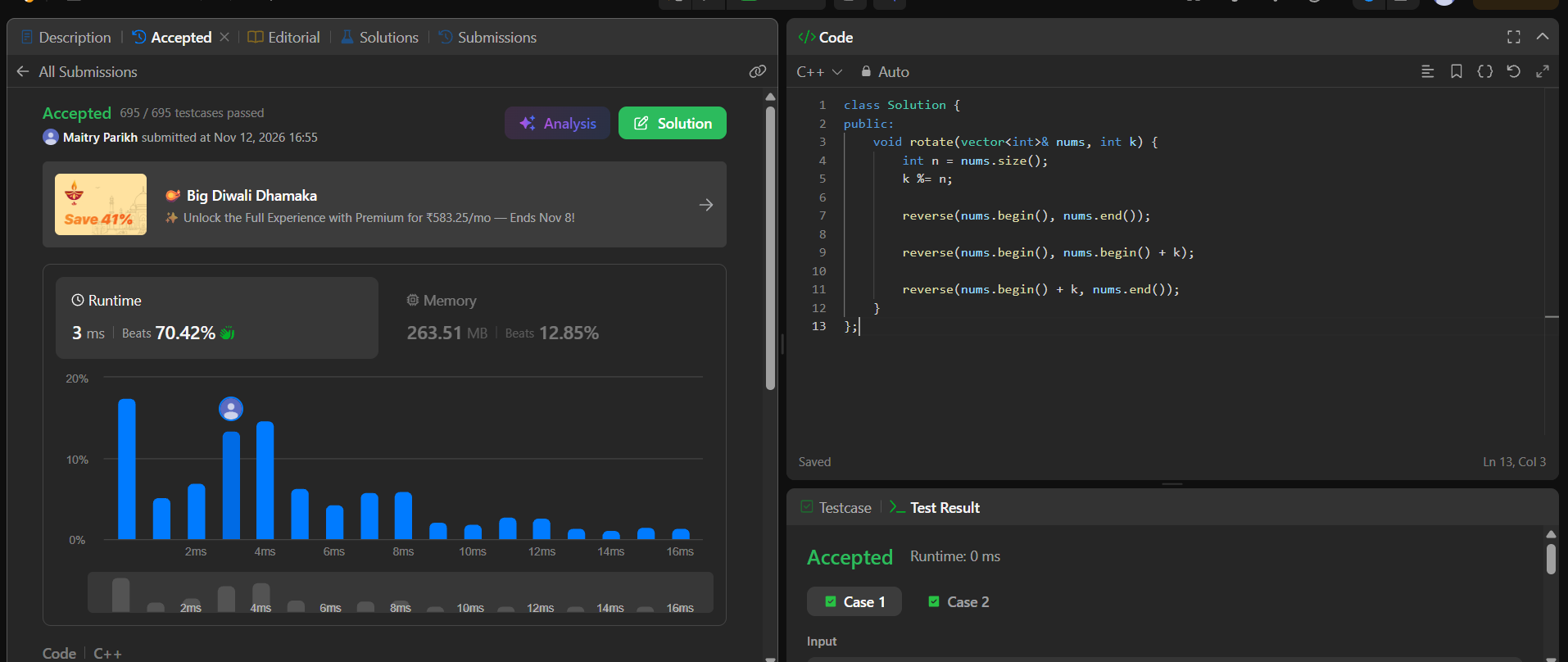
- Reverse the entire array.
- Reverse the first
kelements. - Reverse the remaining
n-kelements.
Let’s see:
Original:       [1,2,3,4,5,6,7]

Reverse all:    [7,6,5,4,3,2,1]

Reverse first 3:[5,6,7,4,3,2,1]

Reverse rest:   [5,6,7,1,2,3,4]
And that’s it!
class Solution {
public:
    void rotate(vector<int>& nums, int k) {
        int n = nums.size();
        k %= n;

        reverse(nums.begin(), nums.end());

        reverse(nums.begin(), nums.begin() + k);

        reverse(nums.begin() + k, nums.end());
    }
};
Code lines explained
k %= nmakes sure we’re not rotating more than necessary.- First, reverse the entire array.
- Then reverse the first
kelements to restore their original order. - Finally, reverse the remaining elements.
Complexity:
- Time: O(n), three reversals.
- Space: O(1), everything happens in-place.