
Here’s the question link on LeetCode 54. Spiral Matrix:
https://leetcode.com/problems/spiral-matrix/description
Contents
Brute Force [Space – O(m × n)]
My first thought is pretty straightforward.
I can start from the top-left corner and move right. Once I reach the boundary, I turn down, then left, then up.
But how do I know whether I’ve already visited an element?
I can maintain another matrix of the same size to keep track of visited elements.
Whenever I visit an element, I mark it as visited.
If the next position is either outside the matrix or already visited, I simply change direction.
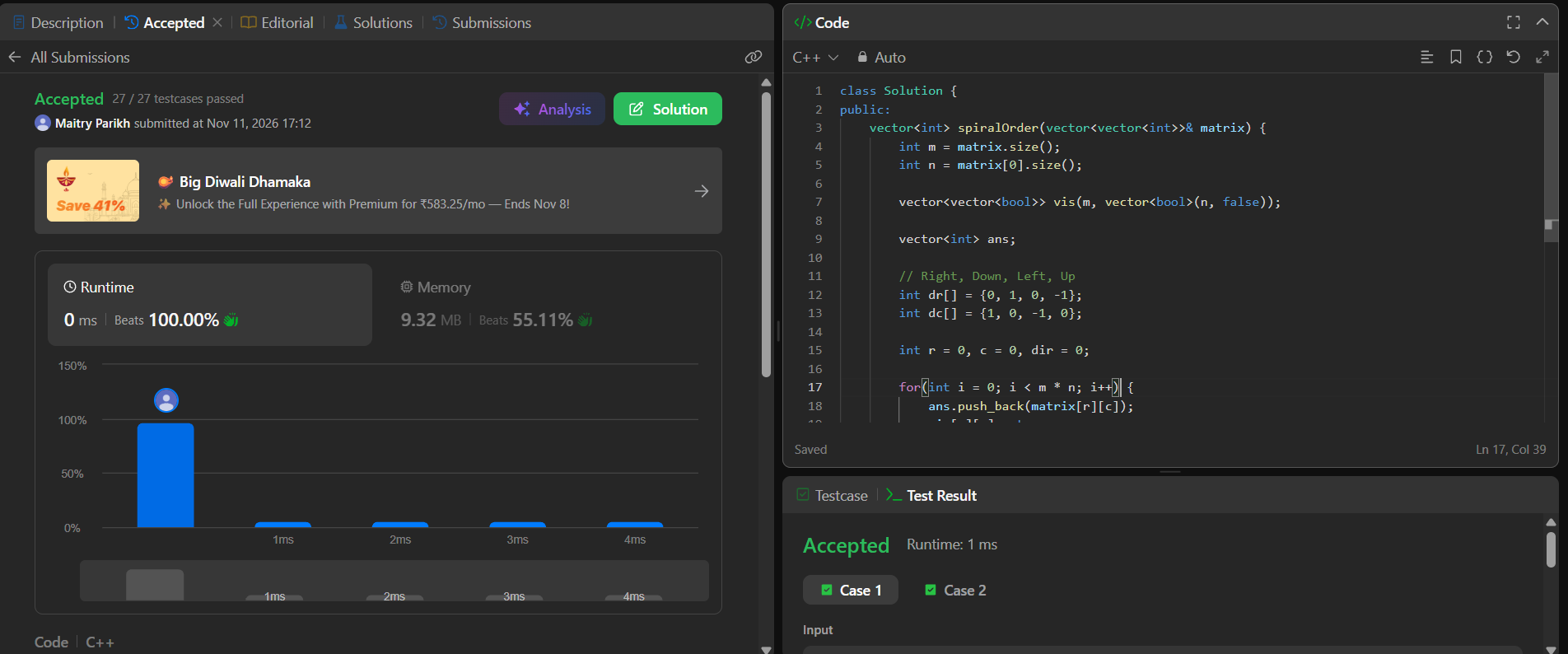
class Solution {
public:
    vector<int> spiralOrder(vector<vector<int>>& matrix) {
        int m = matrix.size();
        int n = matrix[0].size();

        vector<vector<bool>> vis(m, vector<bool>(n, false));

        vector<int> ans;

        // Right, Down, Left, Up
        int dr[] = {0, 1, 0, -1};
        int dc[] = {1, 0, -1, 0};

        int r = 0, c = 0, dir = 0;

        for(int i = 0; i < m * n; i++) {
            ans.push_back(matrix[r][c]);
            vis[r][c] = true;

            int nr = r + dr[dir];
            int nc = c + dc[dir];

            if(nr < 0 || nr >= m || nc < 0 || nc >= n || vis[nr][nc]) {
                dir = (dir + 1) % 4;
            }

            r += dr[dir];
            c += dc[dir];
        }

        return ans;
    }
};
Wait a minute. Do we really need another matrix just to track visited elements?
Think about it.
Instead of checking whether we’ve visited an element, we can simply maintain four boundaries:
top= first unvisited row.bottom= last unvisited row.left= first unvisited column.right= last unvisited column.
Initially, these boundaries cover the entire matrix.
Now we just need to traverse one boundary at a time.
Optimal [Space – O(1)]
Wait a minute. Do we really need another matrix just to track visited elements?
Think about it.
Instead of checking whether we’ve visited an element, we can simply maintain four boundaries:
top= first unvisited row.bottom= last unvisited row.left= first unvisited column.right= last unvisited column.
Initially, these boundaries cover the entire matrix.
Now we just need to traverse one boundary at a time.
- Traverse the top row from left to right. Then move
topdown. - Traverse the right column from top to bottom. Then move
rightleft. - Traverse the bottom row from right to left. Then move
bottomup. - Traverse the left column from bottom to top. Then move
leftright.
Repeat!
Notice that after every complete round, our boundaries shrink and we move towards the center.
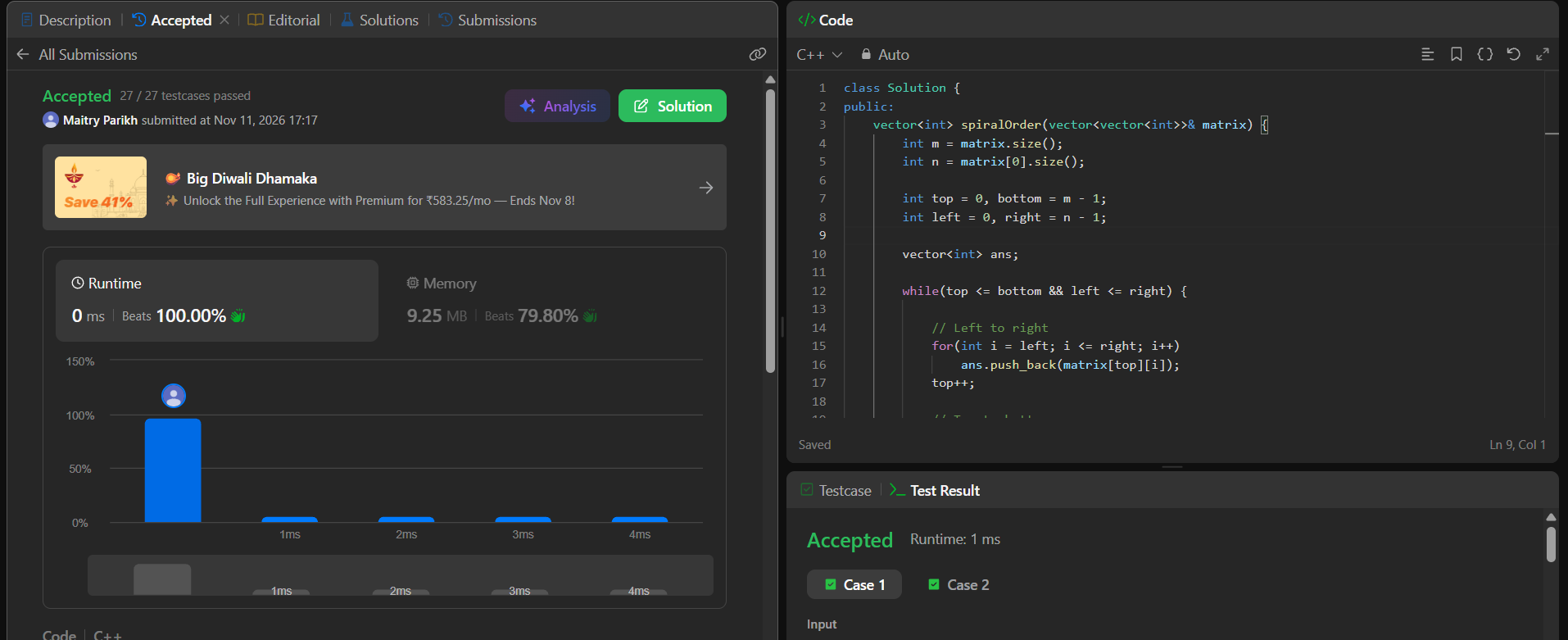
class Solution {
public:
    vector<int> spiralOrder(vector<vector<int>>& matrix) {
        int m = matrix.size();
        int n = matrix[0].size();

        int top = 0, bottom = m - 1;
        int left = 0, right = n - 1;

        vector<int> ans;

        while(top <= bottom && left <= right) {

            // Left to right
            for(int i = left; i <= right; i++)
                ans.push_back(matrix[top][i]);
            top++;

            // Top to bottom
            for(int i = top; i <= bottom; i++)
                ans.push_back(matrix[i][right]);
            right--;

            // Right to left
            if(top <= bottom) {
                for(int i = right; i >= left; i--)
                    ans.push_back(matrix[bottom][i]);
                bottom--;
            }

            // Bottom to top
            if(left <= right) {
                for(int i = bottom; i >= top; i--)
                    ans.push_back(matrix[i][left]);
                left++;
            }
        }

        return ans;
    }
};
That’s it; see you in the next one.